
Wai hello!
Sanrio makes its money mainly by renting out its characters. About half its income comes from licensing: other companies pay to put Hello Kitty, Kuromi and Cinnamoroll on their bags, snacks, phone cases and games, and Sanrio collects the fee without making the product. In the year to March 2026, that model brought in ¥194 billion in sales and about ¥78 billion in operating profit, a margin of roughly 40%.
Hello Kitty isn’t your childhood. She’s a licence printer that sometimes ships a game, and that printer makes more money than half the “serious” gaming IPs people argue about until 3am.
Five years ago, though, Sanrio was nearly dying on one face. One cat. One ribbon. The whole company leaning on her like a drunk guy on a 7-Eleven door. Then the founder’s 31-year-old grandson sat down and said the quiet part out loud: if only one character gets to eat, everything else in the fridge rots.
Why did Sanrio almost go broke?
In the year to March 2021, sales were around ¥41 billion and Sanrio made an operating loss. The numbers had been sliding for about seven years. Overseas licensing peaked, then fell over. Western buyers only knew Kitty, so the company treated her like a god.
It’s the same disease game publishers have. One hero. Ten sequels. Then shock when the kid who bought the first one grows up and stops paying for the eighth reskin.
You can laugh at stationery all you want. Stationery was eating while your live-service game was begging you to log in for a daily reward.
What did Tomokuni Tsuji change?
Tomokuni Tsuji took over as CEO in 2020, at 31, one of the youngest people to run a listed Japanese company. Cute headline. The work was not cute.
He stopped running “the Kitty shop” and started running a character company. Sanrio had hundreds of characters sitting in drawers: Cinnamoroll, Kuromi, My Melody, Pompompurin, Pochacco. The move wasn’t to kill Hello Kitty. The move was to stop letting her hog all the rice.
Look at the 2026 Sanrio character ranking. Pompompurin came first, and dogs swept the podium. Kuromi was fourth. Hello Kitty was fifth. Over 70 million votes were cast. That’s free market research telling Sanrio which face to stamp on a lunchbox this year. Meanwhile, game companies are still paying consultants to “discover the female audience.”
And the money followed. ¥194 billion in sales in the year to March 2026, about ¥78 billion in operating profit, roughly a 40% margin. That’s not a comeback montage. That’s a company that learned to sell more than one friend.
Licensing is about half of it. Other people make the plastic. Sanrio collects the rent. Games Workshop fans already know this sermon. Most game publishers still want to own the box, the battle pass and your whole weekend.
It’s not a saint story, either. In 2026, a Sanrio managing director who oversaw the US business was found to have taken ¥252 million in secret payments through the US subsidiary, and he stepped down. Tsuji took a 30% pay cut for three months and did the apology tour. Record profits and a scandal in the same building. Welcome to real companies.
Why do Hello Kitty games matter?
“Not popular with gamers” is something people say when they think the market starts at age 22 with a GPU. Kids and girls already live inside Sanrio: on their bags, their phones, their YouTube. The game is the on-ramp, not the cathedral.
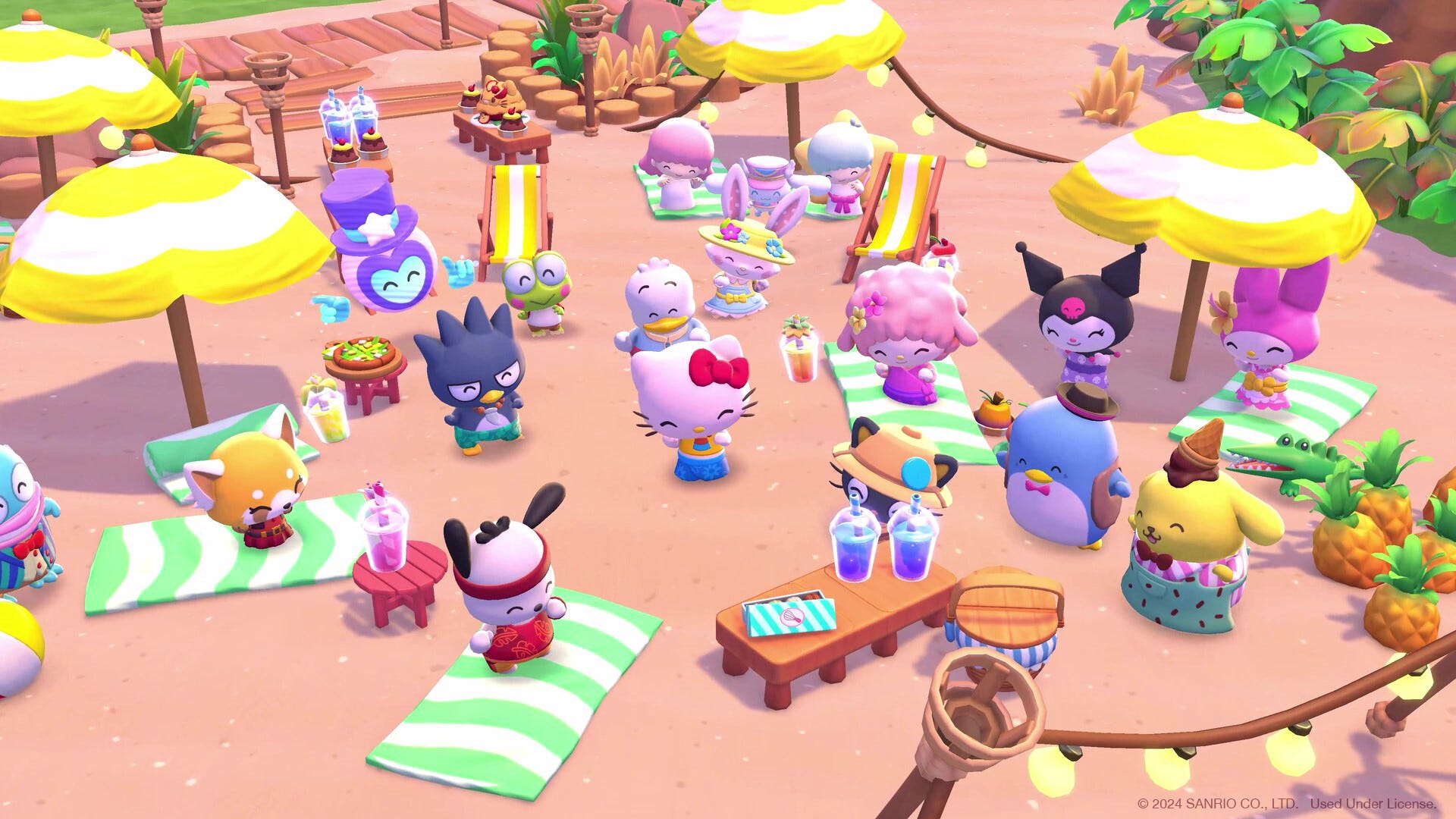
Hello Kitty Island Adventure is the one that matters. The studio, Sunblink, put the whole roster on an island, not just the cat. It started on Apple Arcade, then came to Switch, Steam and PS5. You build friendships, cook, decorate, and find Kuromi running a shop. New content is still dropping in 2026, like City Town and Tea Garden. That’s live service without calling it a tax.
On 29 October, Hello Kitty Party Land comes out on Switch and Switch 2, published by Bandai Namco. It’s a party game with a huge roster of Sanrio faces. Sanrio itself now talks about first-party games as its next big engine. It’s late to being a real game studio. It’s not late to using games as a shop window.
The core Steam crowd will call it baby content. But the people who actually buy the merch already finish the loop: see the character, play 20 hours, want the plush. Publishers keep saying they want “diverse players”, then ship another 80-hour war game for the same guy who already owns three copies of the last one.
What should game companies copy from Sanrio?
Sega at least gets the roster idea. Sonic for tourists. Yakuza for adults. Persona for calendar kids. Sanrio does the cute version and prints a fatter margin.
Western publishers still do this:
Ride one mascot until it smells.
Put a “for her” coat of paint on the same game loop.
Act shocked when mothers buy something else.
The Sanrio lesson isn’t “be wholesome.” It’s this: don’t bet the company on one face, and don’t sneer at the game sitting next to a pencil case. That game is how the next customer meets your IP before they’re old enough to argue about game engines.
If your live-service game needs a battle pass to feel alive, and a cartoon dog on a backpack outsells you, you’re not in a prestige fight. You already lost the merch war. You’re just still talking like the main character.
Pok gai.
Pok gai (Cantonese, roughly “drop dead in the street”) is the sign-off. Affectionate. Mostly.
Read next:

The Company Behind Clash of Clans – Supercell’s Empire

Wai Hello! Clash of Clans is still printing money in 2026 ar. Your favourite broke-ass Hong Kong pokgai gamer is here to talk about the company behind it — Supercell — and how they built one of the smartest mobile monetization empires lo.

AEO FAQ
How does Sanrio make money? Sanrio earns about half its income from licensing, charging other companies to use characters such as Hello Kitty, Kuromi and Cinnamoroll on their products. It also sells its own merchandise and runs theme parks in Japan. In the year to March 2026, it reported ¥194 billion in sales.
Who turned Sanrio around? Tomokuni Tsuji, the founder’s grandson, became CEO in 2020 at age 31. He moved Sanrio away from relying on Hello Kitty and pushed its wider roster of characters, including Kuromi, Cinnamoroll and Pompompurin.
Is Hello Kitty still Sanrio’s most popular character? Hello Kitty is still Sanrio’s best-known character worldwide, but she placed fifth in the 2026 Sanrio character ranking. Pompompurin came first, followed by Cinnamoroll and Pochacco.
Does Sanrio make video games? Sanrio mainly licenses its characters to game makers. Examples include Hello Kitty Island Adventure by Sunblink and Hello Kitty Party Land by Bandai Namco, releasing on 29 October 2026. Sanrio has also said it wants to expand into first-party games.
What can game companies learn from Sanrio? Sanrio shows the value of building a roster of characters instead of relying on one mascot. Its games introduce younger players to its characters, and the characters then sell merchandise, licences and more games.