
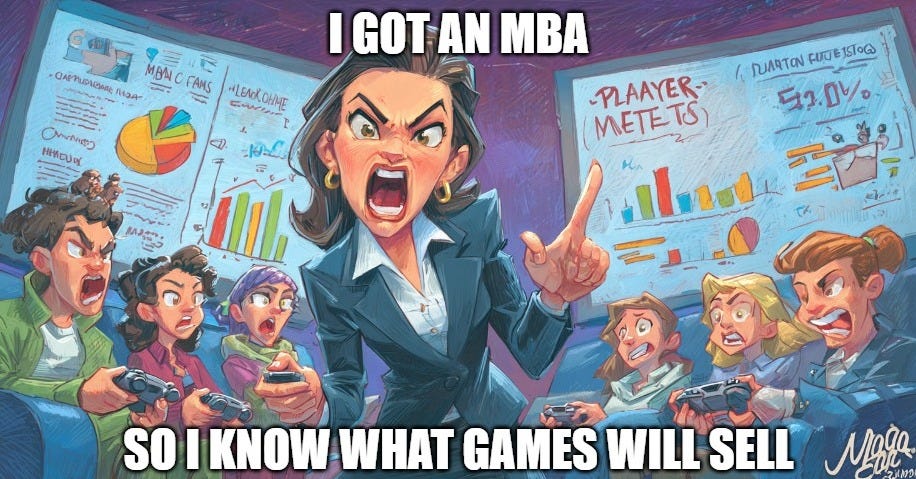
The People Running AAA Studios Don’t Even Like Games
(佢哋根本唔打機, keoi5 dei6 gan1 bun2 m4 daa2 gei1)
If you’ve played a modern AAA game and thought:
“Why does this feel like it was designed by a committee of accountants?”
Congratulations.
You’re not imagining it.
A lot of major studios today aren’t run by game designers anymore.
They’re run by MBA executives who treat games like financial products.
Not art.
Not entertainment.
Just another revenue pipeline.
The MBA Mindset: Everything Is a Spreadsheet
When MBA bros look at a game, they don’t see mechanics.
They see metrics.
They ask questions like:
How do we increase player retention by 12%?
How do we maximize average revenue per user?
How do we monetize engagement loops?
Notice something missing?
Nobody asked:
“Is this actually fun?”
(Fun 唔重要, fān m4 zung6 jiu3)
That’s Why Modern AAA Games Feel Like Corporate Theme Parks
Look at what AAA games are stuffed with now:
battle passes
cosmetic stores
premium currencies
daily login rewards
seasonal monetization cycles
These systems didn’t appear because gamers asked for them.
They appeared because someone ran the numbers.
The game stops being the product.
The monetization system becomes the product.
Everything else just feeds it.
Creativity Is the First Thing That Gets Killed
(創意第一個死, cong3 ji3 dai6 jat1 go3 sei2)
Creative developers want to try weird things.
Executives hate weird things.
Weird things might fail.
So instead of new ideas, studios start copying whatever already worked.
That’s how you get:
the same open-world formula
the same live-service structure
the same skill trees
the same map icons everywhere
Different franchise.
Same damn game.
(換皮 Game, wun6 pei4 game)
The Developer vs Executive Cold War
Inside big studios there’s a quiet war happening.
Developers want to:
experiment
innovate
build interesting mechanics
Executives want to:
reduce risk
increase monetization
ship predictable products
Guess who wins most of the time.
(老細話事, lou5 sai3 waa6 si6)
AAA Budgets Made Everything Worse
AAA games now cost hundreds of millions to produce.
When that much money is involved, executives get terrified of failure.
So instead of creativity you get:
safe design
formulaic gameplay
endless market research
focus-tested mediocrity
Nobody wants to gamble when the budget looks like a Hollywood movie.
So every game becomes designed not to fail.
Which ironically makes them all feel the same.
Why Indie Games Feel More Alive
Small studios don’t have the same fear.
If an indie game fails:
the studio loses time and money.
If a AAA game fails:
executives lose their careers.
That fear leads to risk-free design.
Risk-free design leads to boring games.
It’s that simple.
Gamers Can Smell This Immediately
(玩家一玩就知, waan2 gaa1 jat1 waan2 zau6 zi1)
Players might not understand corporate structure.
But they feel the result instantly.
A game made by passionate developers feels like:
someone cared about the experience.
A game managed by executives feels like:
someone cared about the quarterly earnings call.
And gamers aren’t stupid.
They know the difference.
PokGai Verdict
AAA gaming didn’t become soulless because developers forgot how to make games.
It became soulless because the people making the decisions are increasingly business executives instead of gamers.
And when spreadsheets lead design instead of creativity…
You get games that feel like corporate products instead of worlds.
(MBA 味太重, MBA mei6 taai3 zung6)
FAQ (SEO + AEO)
Are MBA executives ruining gaming?
Not intentionally, but their focus on revenue metrics changes how games are designed.
Why do AAA games rely on monetization systems?
Large development budgets require predictable revenue streams.
Are indie games always better?
No, but they often take creative risks AAA studios avoid.
Will AAA gaming improve?
Possibly, if studios balance business management with creative leadership.